How AI Image Generators Actually Work – From Text Prompt to Final Render
Artificial intelligence image generators feel almost magical. You type a sentence, press generate, and seconds later a detailed, often cinematic image appears.
But behind that simplicity lies a sophisticated technical process involving machine learning, neural networks, and probabilistic modeling.
This article breaks down how AI image generation works - clearly, accurately, and without unnecessary jargon.
1. It Starts with Training on Massive Image Datasets
AI image models are trained on extremely large datasets containing millions - sometimes billions - of image-text pairs.
Each image is paired with descriptive text. During training, the model learns:
-
What objects look like
-
How styles differ
-
How lighting behaves
-
How perspective works
-
How certain words correlate with visual patterns
It does not store images like a database. Instead, it learns statistical patterns that connect language and visual structure.
Think of it as learning the probability distribution of what images look like based on textual descriptions.
2. Understanding Text – Turning Words into Mathematical Meaning
When you type a prompt like:
“A cinematic portrait of a cyberpunk warrior in neon rain”
The system first converts that text into a mathematical representation called an embedding.
This embedding captures semantic meaning:
-
“Cinematic” influences lighting and framing
-
“Cyberpunk” affects color palette and environment
-
“Neon rain” introduces atmospheric elements
The model does not “understand” language like a human. It translates words into vectors - numerical representations of meaning.
3. Diffusion Models – Creating an Image from Noise
Most modern AI image generators use diffusion models.
Here’s the simplified process:
-
The model starts with pure random noise.
-
It gradually removes noise step-by-step.
-
At each step, it nudges the image closer to what the text embedding suggests.
This process happens over dozens of refinement iterations in seconds.
It’s similar to sculpting. Instead of carving stone, the AI removes randomness until structure emerges.
The final result is an image that statistically aligns with your prompt.
4. Why Prompts Matter So Much
Because the model relies on probability distributions, clarity affects output.
Compare:
-
“A dog”
-
“A hyper-realistic golden retriever portrait, soft daylight, 85mm lens, shallow depth of field”
The second prompt provides:
-
Subject specificity
-
Style direction
-
Lighting cues
-
Camera framing
More constraints = narrower probability space = more controlled result.
That’s why prompt engineering exists.
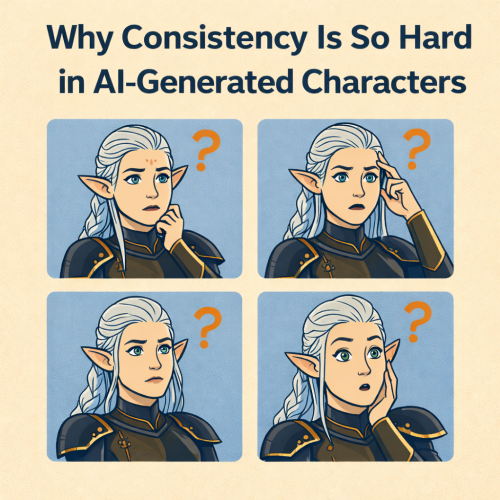
5. Why Results Can Vary Each Time
Even with the same prompt, outputs differ.
This happens because:
-
The process begins with random noise.
-
The model samples from probability distributions.
-
Small changes in early denoising steps amplify later.
Some platforms allow seed control, which locks the initial noise pattern and increases reproducibility.
Without seed control, every generation is a fresh probabilistic interpretation.
6. Styles, Models, and Fine-Tuning
Not all AI image models are identical.
Differences arise from:
-
Training dataset composition
-
Model architecture size
-
Fine-tuning on specific aesthetics (anime, photorealism, illustration, etc.)
-
Reinforcement learning adjustments
Some platforms train specialized models for:
-
Product photography
-
Concept art
-
Architectural visualization
-
Character design
The underlying math is similar, but the learned visual biases differ.
7. Does the AI “Copy” Images?
This is a common misconception.
Modern diffusion models do not retrieve or paste images from their dataset. They generate new images by predicting pixel structures based on learned statistical patterns.
However, legal and ethical discussions remain active regarding training data usage and derivative similarity - which is why copyright frameworks are still evolving.
8. From Generation to Post-Processing
After the diffusion process, additional steps may include:
-
Upscaling
-
Face correction refinement
-
Noise cleanup
-
Color grading adjustments
Many platforms layer these improvements to enhance final quality.
9. Why AI Image Generation Feels So Powerful
The core reason is this:
It compresses years of visual pattern learning into an instant probabilistic synthesis engine.
Instead of manually:
-
Sketching composition
-
Adjusting lighting
-
Rendering materials
-
Refining perspective
You provide direction, and the model calculates a statistically plausible visual interpretation.
It’s not magic.
It’s probability, optimization, and pattern recognition operating at scale.
Final Thoughts
AI image generators operate through:
-
Massive dataset training
-
Text embedding conversion
-
Diffusion-based noise refinement
-
Probabilistic image sampling
Understanding this process helps you write better prompts, control outputs more effectively, and use AI tools strategically rather than randomly.
The technology is complex.
Using it well is about precision.